Why ABM Works Better Than Demand Gen for Enterprise AI Pipeline
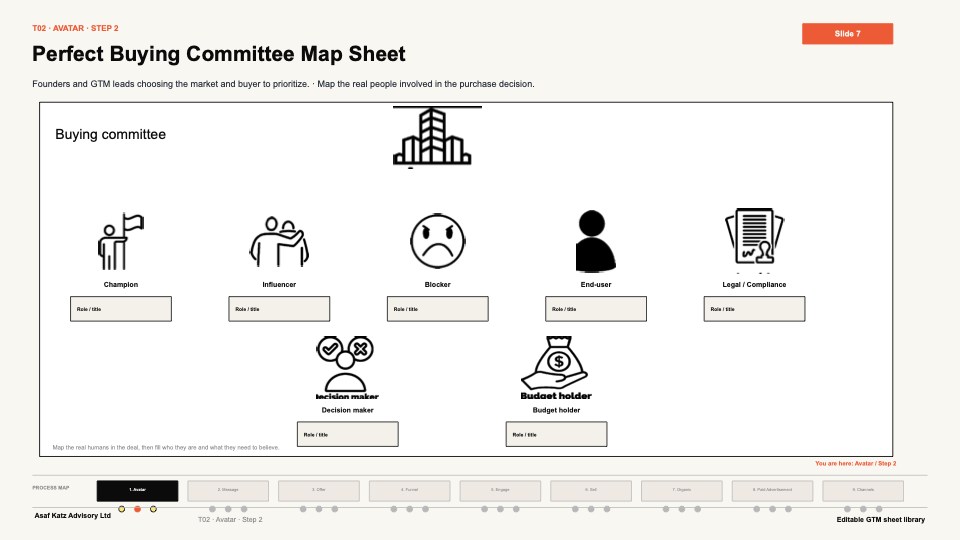
Enterprise AI deals involve buying committees. A CTO evaluates the technical architecture. A head of AI/ML validates model performance. A CISO reviews data governance and security posture. A CFO approves the budget and evaluates ROI. All four need to be convinced before a deal progresses.
Standard demand gen, optimizing for lead volume from a broad ICP, typically reaches only one of these stakeholders. ABM is designed to coordinate engagement across the entire buying committee within a defined set of high-priority accounts.
For AI companies with enterprise deal sizes and 6 to 12 month sales cycles, ABM programs consistently generate better-quality pipeline than broad demand gen. The investment per account is higher. But the conversion rates are significantly higher and the deals that close are larger.
I have closed over $20M in direct sales across deals that looked a lot like this. The pattern I kept seeing: companies were generating leads fine. They were losing committee members they never even knew existed. ABM is the fix for that specific problem.
Building an ABM Program for AI Companies
Step 1: Define your tier-1 target account list. For most AI companies at Series A through Series C, this means 50 to 150 accounts where you have the highest conviction. Companies with the right tech stack, the right size, recent AI initiative signals, and decision-makers who match your ICP. Prioritize accounts where you have an existing warm connection or a reference from a comparable account.
Before you build this list, get your foundation right. Avatar, message, and offer have to be clear first. ABM amplifies whatever you already have. If your positioning is vague, targeting 100 accounts just multiplies that vagueness across 100 buying committees. I rebuilt positioning for 40+ companies before their outreach touched a single prospect. That sequence matters.
Step 2: Map the buying committee. For each target account type, identify the four roles that will influence the decision: technical evaluator (CTO or VP Engineering), technical champion (Head of AI/ML), security and governance gatekeeper (CISO), and economic buyer (CFO or Head of Finance). Build content and touchpoints for each role separately.
Step 3: Layer in live events as the highest-intent touchpoint. An event that draws multiple stakeholders from the same target account simultaneously creates account-level momentum that no individual outreach sequence can match. When a target account's CTO and CISO both attend a relevant webinar, your post-event follow-up is with a warmed committee, not a cold contact.
Across hundreds of campaigns I have run, event invites get accepted 40 to 50 percent of the time. Pitch outreach to the same lists gets 5 to 10 percent. Same contacts, same senders. The ask is the only variable.
Step 4: Use signal monitoring to prioritize follow-up. Not all target accounts are in active evaluation cycles at the same time. Use intent signals, job postings, LinkedIn engagement, conference attendance, earnings call content, to identify which accounts are most likely to engage right now. Allocate your highest-effort follow-up to those accounts. Timing is not a nice-to-have. In long-cycle enterprise deals, catching the window matters as much as the message.
The Event-Led ABM Model for AI Companies
The most efficient ABM motion I have seen for AI companies is built around live events targeted at a defined account list. The structure:
- Identify 50 to 150 tier-1 target accounts
- Design a practitioner-led live event around the specific technical challenge those accounts are navigating right now
- Promote directly to decision-makers at those accounts from verified contact lists
- Run the event with genuine technical credibility, not a thinly veiled product demo
- Follow up within 24 hours with the highest-intent attendees
The result is account-level engagement. Multiple stakeholders from the same account in the same room, all primed for a real conversation rather than a cold pitch.
From my own work: one AI-regulation webinar pulled 754 signups in 26 days, with over 100 from target accounts and zero ad spend. The reason it worked was topic selection, a subject buyers already wanted to discuss, with a voice they already trusted. That event generated $180K in pipeline. At RSA, one person with no booth and no brand booked 38 C-level meetings from 1,266 prospects using 12-word openers and role-matched senders. Neither of those results came from volume. They came from relevance.
Results across programs: 43 qualified meetings in 60 days for one client, 754 webinar signups in 26 days with 100+ from target accounts, recurring event series producing 300 to 800 registrations per event. Events from $6,000.
The Content That Supports AI ABM Programs
Each buying committee role needs content calibrated to their specific concerns.
For the CTO or VP Engineering: Technical architecture deep-dives, benchmark comparisons, integration documentation, latency and cost analysis.
For the Head of AI/ML: Model quality evaluations, fine-tuning documentation, API flexibility examples, real deployment case studies with honest trade-off framing. Honest is the key word. Practitioners spot sanitized case studies immediately.
For the CISO: Security architecture documentation, data handling policies, compliance certifications, governance framework alignment. When I sold into pharmaceutical companies, I learned that buyers inside compliance-heavy organizations do not reward cleverness. They reward clarity and proof. The same is true for CISOs evaluating AI vendors.
For the CFO: ROI models built on real customer data, implementation timeline and cost estimates, risk-adjusted business case frameworks.
ABM content should be specific enough that each stakeholder believes it was designed for their exact concerns. Generic content that tries to speak to everyone at once speaks to no one well. The effort of personalizing by role is what separates ABM from mass marketing in practice, not just in theory.