Microsoft, Google, and Yahoo Tighten Bulk Sender Rules in 2026: What B2B Outbound Teams Must Do Now
As of May 2025, all three major email providers, Google, Yahoo, and Microsoft, fully enforce bulk sender rules that were announced in 2024. In 2026, the enforcement is stricter and less forgiving than at initial rollout. Configurations that previously caused mild performance dips now surface as complete deliverability failures.
For B2B outbound teams, this is not a technical edge case. It is the baseline for whether your emails land at all.
What the Rules Require in 2026
All three providers require the same authentication stack:
- SPF (Sender Policy Framework): Your sending domain must publish a valid SPF record authorizing the IP addresses in your sending infrastructure.
- DKIM (DomainKeys Identified Mail): Every outgoing message must be cryptographically signed with a valid DKIM key.
- DMARC: Your domain must publish a DMARC policy that aligns with SPF and DKIM. A policy of
p=nonestill satisfies the requirement but provides no enforcement.
Beyond authentication, the behavioral thresholds are strict:
- Spam complaint rate must stay under 0.3% for Gmail, Yahoo, and Microsoft. For a sender sending 1,000 emails per day, a single spam complaint puts you at 0.10%, which is within striking distance of the soft threshold.
- Bounce rate must stay under 2%. Lists with high invalid email rates now trigger suppression faster than before.
How This Affects Cold Email Performance
According to Instantly's 2026 Cold Email Benchmark Report, the average cold email reply rate has dropped to 3.43%. This is not primarily a deliverability problem. It is an inbox fatigue problem compounded by the fact that everyone is now using the same signal-based personalization playbooks.
The exception: emails that reference specific buying signals, such as funding rounds, leadership changes, and hiring spikes, achieve response rates of 15 to 25%. That is a five-fold improvement over generic outreach. Signal-based outreach works because it is relevant enough that recipients are less likely to mark it as spam, keeping complaint rates low.
I learned the relevance lesson before email was even part of the picture. I started selling door to door. No brand, no inbound, just a doorbell and an offer. The only thing that kept a door open was whether what I said matched what the person in front of me actually cared about. Cold email is no different. Irrelevant messages get marked as spam. Relevant ones get replies.
What B2B Outbound Teams Must Fix Before Q3
- Audit your authentication setup. Verify SPF, DKIM, and DMARC are correctly configured for every sending domain and subdomain. Broken configurations that were tolerated in 2024 now cause suppression in 2026.
- Clean your lists before sending. Use an email validation service before any outbound campaign. Bounce rates above 2% trigger deliverability flags within days of a new campaign launch.
- Monitor spam complaint rates weekly. Set up Google Postmaster Tools and Yahoo Feedback Loop for every sending domain. One bad week can take months to recover from.
- Add domain warmup for new infrastructure. Start at 5 to 10 emails per day per new domain and increase over four to six weeks, per Instantly's 2026 benchmarks.
A note on foundation: none of these fixes matter if your underlying message is wrong. I have seen teams with perfect authentication still burn their domains because the copy was irrelevant and the list was too broad. Authentication keeps you in the inbox. Relevance keeps you out of spam reports.
The Alternative Motion: Event-Led Pipeline
Cold email deliverability problems are a tax on volume-based outbound. The higher you scale, the more exposure you have to complaint rate spikes and list quality decay.
There is a different way to build pipeline. At RSA, one person with no booth and no brand booked 38 C-level meetings from 1,266 prospects using 12-word openers and role-matched senders. The approach was connect first, pitch later. No deliverability risk. For a global payments enterprise, we booked meetings with brands like Apple, Levi's, and Nespresso at under $40 per meeting, compared to the $300 to $1,500 alternatives. Across hundreds of campaigns I have run, event invites get accepted 40 to 50 percent of the time. Pitch outreach gets 5 to 10. Same lists, same senders. The ask is the variable.
The event-led model works because it inverts the logic. You invite a curated set of target accounts to something worth attending, the event filters for genuine interest, and you follow up only with people who raised their hand. No list decay. No complaint rate exposure. No deliverability guesswork.
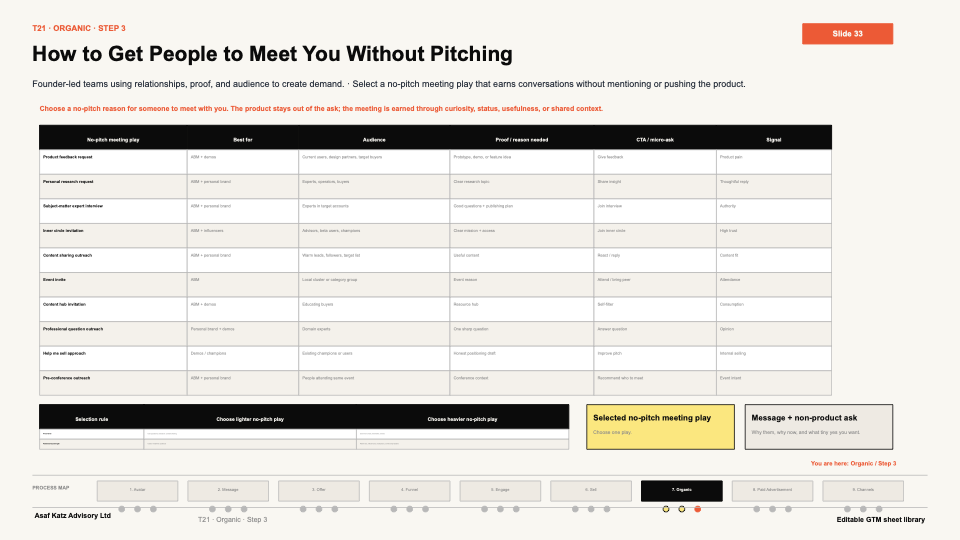
If your pipeline depends on cold email volume to survive, tightening deliverability rules are a structural risk, not a configuration problem. The configuration fixes above will help. But the more durable move is building a motion that does not require recipients to tolerate your outreach. It requires them to want it.
Take the free 60-second check to see how we build pipeline that does not depend on cold email volume.