What is Refine Labs, and why do teams look for an alternative?
Refine Labs is a demand generation advisory firm associated with the dark social and demand creation methodology. Their work focuses on helping B2B companies shift from lead-capture-first thinking to demand-first thinking: build category authority, create genuine buyer intent, and let qualified buyers raise their hand rather than capturing contacts who have not yet formed real interest.
The intellectual framework is sound. The problem many clients encounter is that a strong demand strategy still requires someone to execute it. Refine Labs operates primarily as a consulting and advisory partner. You receive frameworks, guidance, and expertise. You, or your team, still have to produce the content, run the experiments, build the community, and generate the pipeline. For companies that lack the in-house capacity to execute a sophisticated demand program, the strategy alone does not move the needle.
I have lived this problem from both sides. My own agency went from 20 clients to zero. The diagnosis took a while to see clearly: I was selling execution while my clients' real problem was foundation. Strategy without execution is just expensive homework. Execution without foundation is just noise at scale. The fix required me to handle both.
What does event-led execution look like?
Event-led pipeline is a fully executed motion, not a strategy deliverable. The whole program runs from topic selection through meeting booking. The motion runs in five steps.
Listen. Scan what your target buyers are already discussing in LinkedIn threads, conference panels, community forums, and deal postmortems. The event topic comes from their existing conversations, not from your marketing team's assumptions about what matters.
Host a live event. A focused 45-to-60-minute session built around the exact problem buyers are actively wrestling with. A panel, a roundtable, or a workshop where the content is useful independent of your product. The event earns credibility through substance, not pitch.
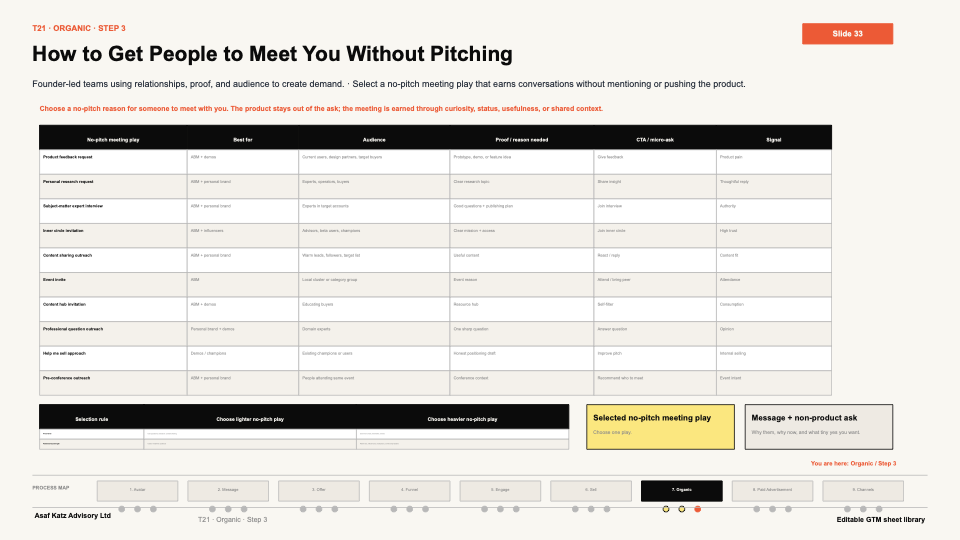
Invite the right people. Outreach that offers buyers something worth their 45 minutes gets a meaningfully different response than a pitch that asks for a meeting. Across hundreds of campaigns I have run, event invites get accepted 40 to 50 percent of the time. Pitch outreach gets 5 to 10. Same lists, same senders. The ask is the variable.
Run the event. A well-run live room creates group trust and peer conversation that individual outreach cannot replicate. Attendees experience your brand as a facilitator of useful discussions rather than a vendor seeking attention.
Follow up with the warmest attendees. After the event you know exactly who showed up, who engaged, and who stayed until the end. Those signals identify your warmest contacts. Follow-up from a shared event context converts at a meaningfully higher rate than cold outreach.
What results does event-led execution produce?
One AI-regulation webinar pulled 754 signups in 26 days, with more than 100 attendees from named target accounts, zero ad spend, and $180K in pipeline generated. The topic came from something buyers were already trying to figure out, paired with a voice they already trusted. That combination is why it worked.
At RSA Conference, a targeted outreach campaign using role-matched senders and 12-word openers produced 38 C-level meetings from 1,266 prospects, 519 connections, 161 conversations. That conversion rate requires that the first interaction be something the buyer genuinely values, not a cold pitch.
Across recurring event series I have run, live attendance runs from 460 to 577 senior attendees per episode, built from zero. My own live show, Risk Takers, sits in that range consistently. A separate 60-day effort produced 43 qualified meetings through event-led outreach and structured follow-up.
One more data point worth knowing: when Vendict rebuilt their ICP, sharpened their narrative, and launched a webinar motion, their VP Marketing put it plainly. Their webinars got so popular they turned them into a podcast. Thousands of leads last year.
How does this compare to what Refine Labs offers?
What Refine Labs gives you: Strategic advisory on demand creation, dark social, and category design. You receive frameworks, recommendations, and expertise. Execution remains your responsibility.
What event-led execution gives you: A fully run program that produces pipeline. You receive meetings from genuine buyer interest, not a strategy document that requires internal capacity to act on.
Both approaches share the insight that demand creation outperforms lead capture in the long run. The difference is who does the work.
On the output you receive: Refine Labs delivers strategy. Event-led delivers booked meetings. For companies with a small marketing team or a revenue target that cannot wait for a 6-to-12-month brand-building program, execution matters more than strategic clarity.
On pricing: Refine Labs advisory retainers are significant. Event-led pipeline typically starts around $6,000 per event, with program pricing for ongoing work. You are paying for results you can measure in meetings, not frameworks.
On timelines: Strategic demand programs take quarters to show results at scale. A single event produces measurable pipeline within 30 to 45 days of kickoff.
Who is this right for?
Event-led execution works best for B2B teams where:
- The team lacks the in-house bandwidth to execute a sophisticated demand program independently.
- Revenue targets require pipeline within a quarter, not a brand-building program over 12 months.
- Senior buyers are the target and they respond to useful peer conversations, not cold outreach.
- The team wants a done-for-you motion rather than an advisory relationship.
This is especially strong for cybersecurity vendors, fintech companies, and enterprise SaaS, where the buyer is senior, skeptical of vendor outreach, and genuinely attends peer events. When I ran a targeting campaign for a global payments enterprise, we booked meetings with brands like Apple, Levi's, and Nespresso using native-language outreach across four countries, at under $40 per meeting versus the $300 to $1,500 alternatives. The event-first framing is what made the ask land.
One thing I will say directly: if your foundation is weak, meaning your ICP is vague, your message is generic, or your offer is unclear, no execution motion fixes that. I check for this before anything else. AI amplifies whatever exists, including the broken parts. Stage calibration comes first.
Common questions before switching
Do you handle the strategy, or just execution? The motion starts by making the offer sharp and identifying the right topic from real buyer signals. Strategy and execution are both part of the program.
What if we want to build internal capability over time? Many teams use event-led pipeline to generate revenue now while building internal content and community capacity in parallel. The two are not in conflict.
How long until we see results? Events fill within weeks. Meetings are booked in the weeks following. A full event cycle produces measurable pipeline within 30 to 45 days.
Take the free 60-second check to see if your offer is ready.