How Low Have Cold Email Reply Rates Actually Fallen?
The Instantly 2026 Benchmark Report put the average cold email reply rate at 3.43%, the lowest on record. The broader B2B cold email range sits between 1% and 5%, down from roughly 7% just two years ago. That is a decline of more than 50% in reply rate performance over 24 months, during a period when email sending volume increased substantially.
The math is getting worse, not better. More emails, fewer replies, lower deliverability, shorter patience.
B2B buyers now receive more than 120 sales emails every single week. At that volume, every cold email you send is competing with 119 others for a moment of attention from a person who has already mentally opted out of the format.
I have watched this play out firsthand. I started my career selling door to door. No brand, no inbound, just a doorbell and an offer. That experience taught me one thing: relevance is the only thing that keeps a door open. Cold email in 2026 is the opposite of relevant. It is a format that has trained buyers to close the door before you finish your first sentence.
What Three Structural Forces Are Killing Cold Email?
The decline in cold email performance is not a temporary dip. It reflects three structural shifts that are not going to reverse.
First, inbox saturation. When the average buyer gets 120 or more sales emails per week, the probability of any individual email getting a genuine read drops to near zero. AI-powered inbox tools have made the filtering even more aggressive. Many cold emails now do not reach the primary inbox at all.
Second, AI spam filters. Enterprise email providers have deployed sophisticated models trained specifically to identify and route cold sales emails away from primary inboxes. The signals these models use, including domain age, sending patterns, template language, and personalization depth, are increasingly difficult to game without compromising deliverability entirely.
Third, buyer preference shift. 61% of B2B buyers now prefer a completely rep-free buying experience, according to Gartner. This is not a fringe preference. It is a majority position, and it is rising. Cold email is structurally misaligned with how the majority of B2B buyers want to be sold to in 2026.
What Does Signal-Based Outbound Actually Deliver?
The teams outperforming the 3.43% average are not working harder on cold email. They have switched to signal-based outbound: outreach triggered by real-time buying signals rather than static lists.
Signal-based outbound consistently delivers 15 to 25% reply rates for practitioners who implement it well. Elite teams exceed 30%. The mechanism is simple. When outreach is triggered by a real signal, a funding round, a leadership change, a hiring pattern, a technology adoption, it arrives at a moment of genuine relevance.
Signal-specific personalization achieves an 18% response rate, five times the generic average. That gap is not about writing quality. It is about timing and relevance. A cold email sent to the right person at the right moment, about the right thing, behaves completely differently than a templated blast.
I saw this most clearly at RSA. One person, no booth, no brand, booked 38 C-level meetings from 1,266 prospects. The approach used 12-word openers, role-matched senders (technical founder to AppSec leads, CEO to CISOs), and connection before pitch. 519 connections accepted. 161 conversations opened. The signal was the context of the event itself. The outreach was built around that relevance, not around a generic pitch.
Why Events Are the Ultimate Buying Signal
Signal-based outbound works because relevance drives response. But there is a channel that does not require you to detect buying signals after the fact. It generates them upfront.
When a buyer registers for and attends a live webinar on a topic specific to their role and pain, they have just sent the clearest possible buying signal. They showed up. They chose to spend 60 minutes of their day on this problem. They are not a cold prospect. They are a pre-qualified lead who self-identified their interest.
From my own work: one AI-regulation webinar pulled 754 signups in 26 days, with more than 100 from target accounts, zero ad spend, and $180K in pipeline generated. The topic was something buyers already wanted to discuss. The voice was one they already trusted. The follow-up was not cold. It was a continuation of a conversation they had already started. My recurring event series produces 300 to 800 registrations per event. Risk Takers, my own live show, draws 460 to 577 live senior attendees per episode, built from zero. Every one of those attendees is a raised hand, not a scraped name.
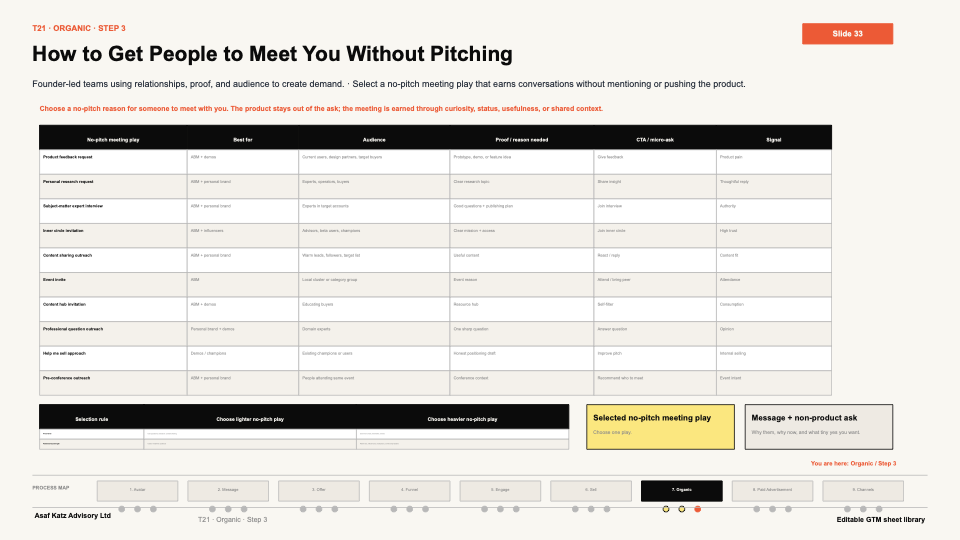
Across hundreds of campaigns I have run, event invites get accepted 40 to 50% of the time. Pitch outreach to the same lists, with the same senders, gets 5 to 10%. The ask is the only variable. Inviting someone to learn something is a fundamentally different request than asking them to sit through a sales call.
How Does the Event-Led Motion Compare to Cold Email at Scale?
Consider the comparison directly. A cold email campaign to 10,000 prospects at 3.43% reply rate produces 343 replies. Most of those are not interested or are asking to be removed. A single event producing 500 live attendees from a curated target account list generates 43 qualified meetings in 60 days through structured follow-up. I have seen that number hold across multiple clients.
The event path is not just a higher response rate. It is a different category of conversation. The meeting that follows an event is with someone who chose to engage. The meeting that follows a cold email is with someone you convinced to give you 15 minutes.
Those two meetings are not equivalent. The pipeline they produce is not equivalent either.
Cold email as the primary pipeline driver is no longer a viable strategy for B2B sales teams that need predictable, qualified meeting flow. The 2026 data is conclusive. The teams adapting fastest are the ones replacing it, not optimizing it.